Many people first hear the words “hiatal hernia” after an endoscopy or an X-ray ordered for stubborn heartburn. The natural next question is whether it means an operation. For most patients, the answer is no, at least not right away. But certain symptoms and certain kinds of hiatal hernia do point clearly toward surgery, and knowing the difference helps you have a sharper conversation with your surgeon.
What Happens With a Hiatal Hernia?
The diaphragm is the sheet of muscle that separates your chest from your abdomen. It has a small opening called the hiatus, where the esophagus passes through on its way to the stomach.

A hiatal hernia occurs when part of the stomach pushes up through that opening into the chest cavity. Aging tissue, obesity, pregnancy, and repeated strain from heavy coughing or vomiting can all weaken the hiatus enough for the stomach to slip through.
Hiatal hernias are common, especially past middle age, though younger adults develop them too. A small one often causes nothing at all, and many people carry one for years without ever knowing. The trouble starts when the hernia disrupts the valve that normally keeps stomach acid where it belongs. That is why so many cases show up as reflux rather than as a bulge you can see or feel.
Why the Type of Hernia Matters
Not all hiatal hernias behave the same way, and the type largely shapes whether surgery enters the picture.
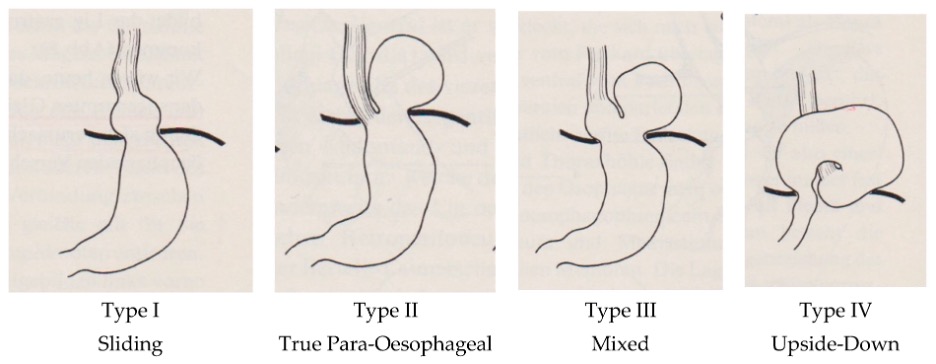
Figure 1
Established typing of hiatal hernias by Skinner and Belsey in 1967, subdivided into four types [23].
Sliding Hiatal Hernias
Most hiatal hernias are the sliding variety. The junction where the esophagus meets the stomach slides up above the diaphragm and often back down again with movement and breathing. These tend to be smaller and closely tied to acid reflux. Symptoms usually respond to medication and lifestyle changes, so surgery is the exception rather than the rule.
Paraesophageal Hernias
Less common but more concerning is the paraesophageal hernia, where part of the stomach squeezes up alongside the esophagus while the valve stays in its usual position.
These can grow large, and they carry a risk that the stomach becomes trapped or twisted. For that reason, surgeons watch paraesophageal hernias more closely and often recommend repair sooner, even when a patient’s symptoms are mild.
The Signs That Point Toward Surgery
Surgery becomes a better option when a hernia keeps causing problems that conservative care cannot resolve. The clearest signal is reflux that continues despite consistent medication or reflux severe enough that a person does not want to depend on acid-suppressing drugs indefinitely.

Other signs include:
- Persistent chest pain, difficulty swallowing, or regurgitation of food
- Damage to the esophagus, such as inflammation, ulcers, or Barrett’s esophagus, from ongoing acid exposure
- A large hernia that crowds the chest and makes breathing or eating uncomfortable
- Anemia from slow bleeding, where the stomach is pinched against the diaphragm
Choosing to operate is rarely about a single test result. It reflects the whole pattern of symptoms, how much they interfere with daily life, and what continued acid exposure is doing to the esophagus over time. Persistent reflux tied to a hernia is one reason the risks of leaving a hernia untreated are worth taking seriously.
When a Hiatal Hernia Becomes Urgent
Occasionally a paraesophageal hernia turns into an emergency. If the trapped portion of stomach twists, its blood supply can be cut off, a situation called strangulation. Sudden, severe chest or upper abdominal pain, retching without being able to bring anything up, and an abrupt inability to swallow are warning signs that call for immediate care. These cases are uncommon, but they explain why surgeons do not dismiss a large paraesophageal hernia even in someone who feels mostly fine.
What Hiatal Hernia Repair Involves
Modern hiatal hernia surgery is almost always minimally invasive.
The surgeon eases the stomach back into the abdomen, tightens the widened hiatus, and usually wraps the upper part of the stomach around the lower esophagus to rebuild the anti-reflux valve, a step known as fundoplication. Most repairs go through a few small incisions.
Both laparoscopic and robotic hernia repair use small incisions and a camera, though the robotic platform gives the surgeon a magnified 3D view and greater range of motion for the delicate work around the esophagus. Many patients go home within a day or two and return to light activity soon after.
The board-certified general surgeons at Agave Surgery, a Dignity Health Medical Group Arizona, specialize in minimally invasive hernia repair and perform these procedures routinely. Their combined experience with both hernia surgery and chronic acid reflux makes them one of the Phoenix area’s most experienced teams for treating the condition where those two problems overlap.
Ready to find out whether your hiatal hernia needs surgery or can be managed without it? Schedule an appointment at one of Agave Surgery’s convenient locations across the Phoenix area.
Figure 1: Skinner, D.B.; Belsey, R.H. Surgical management of esophageal reflux and hiatus hernia. Long-term results with 1,030 patients. J. Thorac. Cardiovasc. Surg. 1967, 53, 33–54. [Google Scholar] [CrossRef] [PubMed]